Introduction
Introduction to Escape Routes
In this topic, we provide an overview of Escape Routes, including Driftdown (engine failure) and Oxygen (cabin decompression) routes designed to reach a safe altitude and airport. It also explains the two Driftdown methods—Weight Reduction and Escape Routes—and highlights Route Optimization solutions (Expanded Route and Prioritized Direct) that improve safety and efficiency.
We estimate that this will take 7 minutes to complete.
This module provides a brief overview of Escape Routes such as engine failure (Driftdown Escape Routes) or cabin decompression (Oxygen Escape Routes) to reach a safe altitude and airport. Additionally, it explains the two methods used for Driftdown (Method 1: Weight Reduction and Method 2: Escape Routes), and the two solutions for Route Optimization (Expanded Route (RTE)) and Prioritized Direct (DCT)), which enhance safety and operational feasibility during in-flight emergencies.
Key points:
- Understand how Escape Routes help maintain safety in high terrain areas.
- Learn about how Oxygen Endurance and how to handle engine failure emergencies.
- Gain knowledge about Escape Routes for optimized emergency paths.
Detailed Explanation
What is an Escape Route?
Escape Routes are specially designed flight paths that help Pilots navigate safely around terrain during emergencies like cabin decompression (Oxygen Escape Routes) or engine failure (Driftdown Escape Routes). These routes ensure the aircraft reach a safe altitude and airport for landing, especially when operating in areas where the Minimum Off-Route Altitude (MORA) is greater than 10,000 feet above sea level. An Escape Route is generated by plotting and confirming a safe path (for the plane) from a diversion waypoint to a lower altitude (low-MORA) area, ultimately leading to a suitable airport.
Note: Descent is not a factor in this calculation, as Escape Routes are a purely lateral calculation of how much distance can be covered at the selected cruise profile. To validate that the endurance time can be satisfied, a MORA check is performed at the varying time points along the Escape Route.
Oxygen Escape Routes
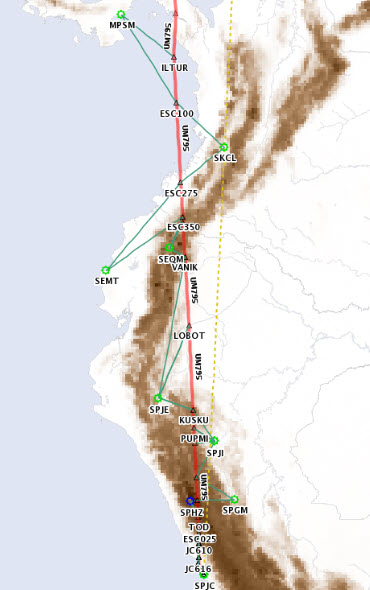
Oxygen Escape Routes are used if the cabin pressure suddenly drops (rapid decompression). These routes are defined as decompression emergencies, and provide a safe lateral path at flight level (FL) 100. The lateral path to the area of lower terrain must be completed within the length of time the onboard oxygen supply can support passengers in order for the Escape Route to be validated. It will include a path that will reach a safe airport. They are based on oxygen endurance limits and utilize normal cruise performance with all engines operative.
Note: This type of Escape Route assumes all engines are working and follows the selected cruise speed.
Example
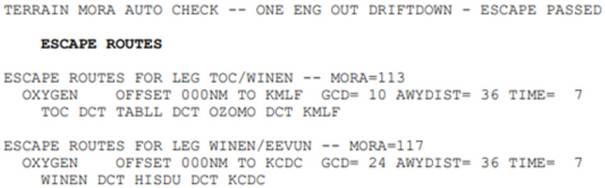
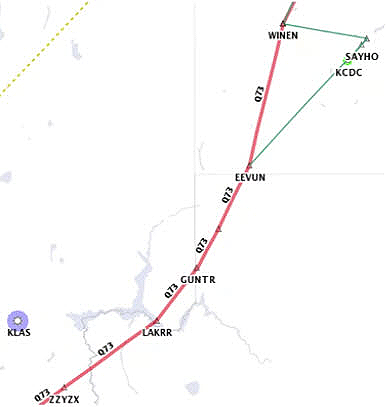
The image to the right displays an Oxygen Escape Route, as shown in the Map panel. The text below displays what appears in the Flight Package.
Oxygen Endurance Table
The Oxygen Endurance table describes how long the aircraft can sustain the passengers with the on-board oxygen supply.
HINT
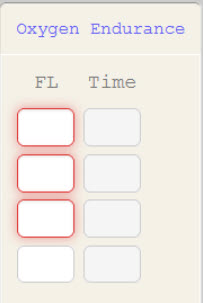
When it is not populated, the additional rows disappear. If they remain blank instead of being removed, they’re highlighted in red.
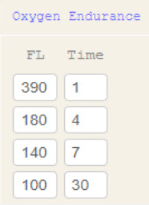
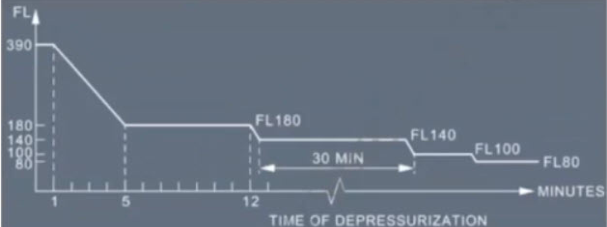
Example - The table and image below demonstrate how the Oxygen Endurance provided by an aircraft manufacturer is represented within the N-Flight Planning (NFP) (Aircraft Characteristics) fields. These values can be adjusted to reflect the customer’s specific fleet.
Driftdown
When an engine fails, aircraft performance becomes increasingly limited, especially at higher FL. The aircraft can no longer safely maintain its current altitude, so Pilots must either:
- plan the flight with a reduced weight to allow safe operation at higher FL
- descend to a lower FL where the remaining engine can sustain safe flight.
There are two primary methods for handling Driftdown engine-out scenarios:
- Method 1: Weight Reduction
- Method 2: Escape Routes.
Method 1: Weight Reduction
This method calculates the maximum flight level feasible based on aircraft weight, temperature, and engine loss performance (one or half engine out). The route as planned may require reducing payload (reducing cargo, weight, fuel, etc.) to maintain a safe FL clear of terrain.
Method 2: Escape Routes
These routes are used during engine failure to provide a path for the aircraft to descend safely while clearing terrain. If an engine fails, the plane needs to descend to a lower altitude where it can still safely fly. These routes rely on drift-down performance assumptions, accounting for reduced engine power and aircraft weight. These routes plan a safe path through the terrain. These routes rely on drift-down performance assumptions, accounting for reduced engine power and aircraft weight. These routes plan a safe path through the terrain. It creates a path that keeps the plane clear of terrain based on the aircraft's actual weight and fuel burned. Starting at the Top of Climb (TOC) waypoint and ending at Top of Descent (TOD), it considers fuel burn and aircraft weight changes over the flight. This provides a tailored descent path for safe engine-out flight.
Solutions for Escape Routes
There are two solutions for developing Escape Routes in N-Flight Planning (NFP):
- Expanded RTE (Old Solution)
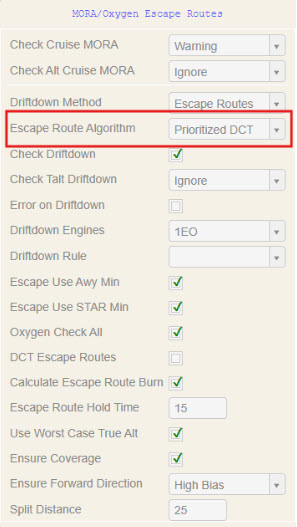
- Prioritized DCT (New Solution).
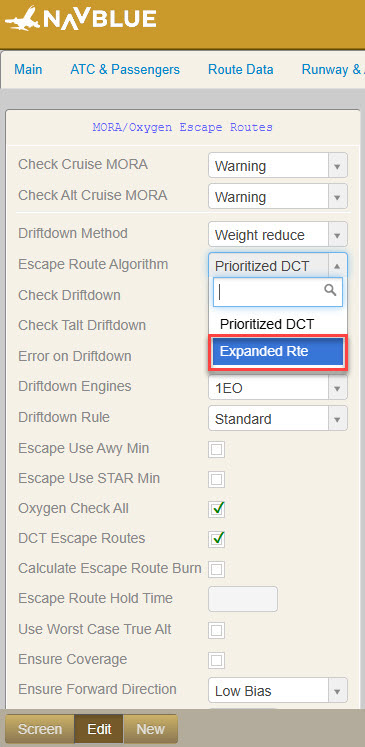
Expanded RTE (Old Solution)
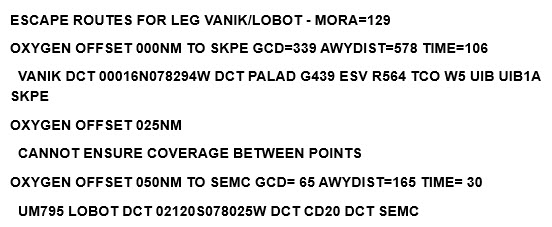
This solution identifies waypoints with Minimum Off-Route Altitude (MORA) above 10,000 feet and generates a lateral path that avoids terrain. This leads to a safe airport using airways or coordinates.It provides Great Circle Distance (GCD), Airway Distance (AWD), Time (in minutes), and optional Fuel Data. However, it does not include Altitude, Speed, and Descent Profiles, as these variables are determined by the Pilot and are not calculated in the Flight Plan. The resulting routes are often complex and may be impractical during emergency situations. Moreover, the system can not guarantee complete coverage between points and frequently fails to generate adequate Escape Routes. While escape routes are not required when MORA is below the FL 100 threshold, such failures in these areas are unacceptable.
Prioritized DCT (New Solution)
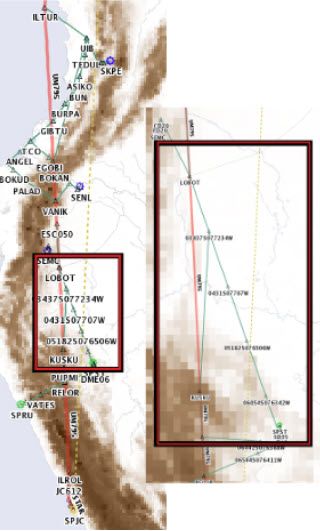
The Prioritized DCT solution generates direct, optimized paths to safe and suitable airports with speed profiles. It also:
- Checks the remainder of the flight route as well as the entire route to the destination.
- Performs effectively across all flight phases, since only route legs with a MORA above FL 100 require escape routes—simplifying their use.
- Improves route clarity and enhances operational feasibility by identifying viable escape paths.
- Provides a more practical option for managing flight emergencies.