
Introduction
ETOPS Group
This topic covers the ETOPS group on the Plan Screen. You will learn how each option in the group is used by the N-FP system. You will also see a demonstration of ETOPS functionality along with a review of the dynamic and static ETOPS generation methods.
We estimate that this will take 8 minutes to complete.
Detailed Explanation
ETOPS Group
The ETOPS group on the Plan screen provides you with the fields that you need to complete if the flight utilizes ETOPS (Extended Twin-Engine Operations Standards). If you have the functionality enabled, N-FP will automatically select ETOPS, and EEP/EXP stations, and populate the corresponding fields in the ETOPS group. Fields that have been automatically populated by the system can be manually changed.
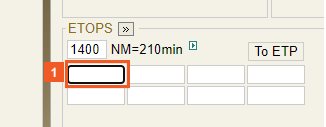
 Click the first ETOPS input field.
Up to eight valid ETOPS stations can be entered. If you enter an invalid station, the field turns pink.
 Enter CYBD into the ETOPS field.
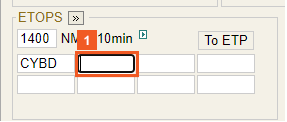
 Click the second ETOPS input field.
 Enter PAYA into the second ETOPS field.
Station information displays in the Info panel when you enter it. You can navigate through information using the tabs in the panel.
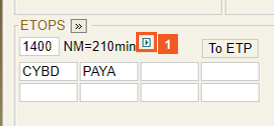
 Click the ETOPS green arrow button.
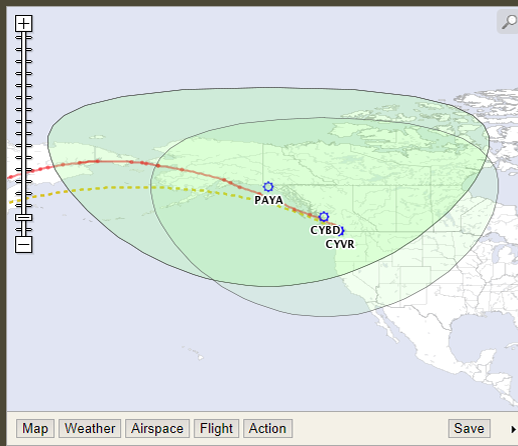
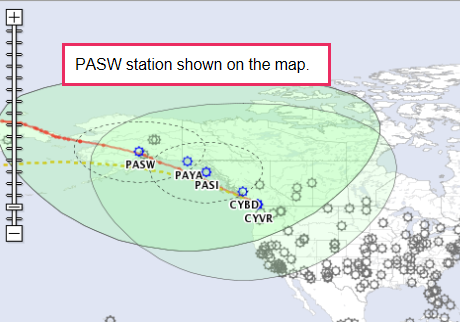
ETOPS circles are shown on the map if you have them enabled. Also the station is highlighted on the map.
Minutes / NM: Some aircraft are configured in Aircraft Characteristics webFOMS so that their ETOPS circle is defined in terms of time (minutes), while others are defined in terms of distance (nautical miles).
- If your aircraft is configured in terms of ETOPS time, the Minutes/NM field displays the ETOPS time, i.e., the number of minutes’ diversion time permissible from an adequate airport.
- If your aircraft is configured in terms of ETOPS distance, the Minutes/NM field displays the ETOPS distance, i.e., the number of nautical miles’ diversion permissible from an adequate airport. The static label to the Minutes/NM field displays nm = X minutes where X is the time value that corresponds with the entered distance.
Clicking on the informational context arrow to the right of the Minutes/NM field pulls values from the ETOPS Time/Distance table in Aircraft Characteristics webFOMS, if populated. If not populated, it just shows the time or distance specified in the default ETOPS Min or ETOPS Distance entries in Aircraft Characteristics webFOMS.
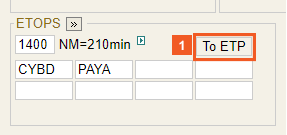
 Click the To ETP button.
To ETP: This button allows you to copy the ETOPS stations into the ETP section so that those stations may be used as ETPs. This will erase any previously entered ETP pairs.
- If there is only one ETOPS station, then no ETP pairs will be created.
- The first ETOPS station will only be used as the Out station of the first ETP pair.
- The second ETOPS station will be used as the In station of the first ETP pair and the Out station of the second ETP pair (provided that there is another ETOPS station for the In station).
- If there are any invalid ETOPS stations, then the To ETP button is disabled.
- Seven ETOPS stations will result in six ETP pairs.
- Only the maximum number of ETP pairs will be created. Any extra ETOPS stations will be ignored.
Note: This button is disabled if no ETP policies exist in the database.
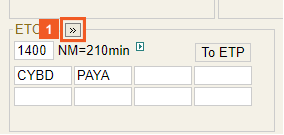
 Click the
  button.
Click the >> button to expand.
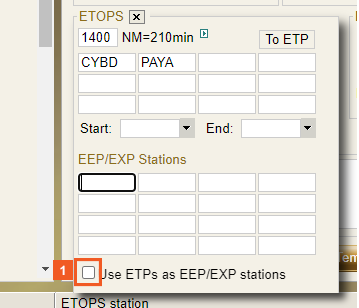
 Click the Use ETPs as EEP/EXP stations check box.
EEP / EXP Stations: The EEP/EXP Stations allow you to enter a list of up to 16 EEP/EXP stations. Sixty minute circles around these stations are used to determine ETOPS entry and exit points.
- When an EEP/EXP station is entered, it is drawn on the map if the ETOPS map button has been turned on.
- It is an error to specify an ETOPS ending waypoint if one or more EEP/EXP stations have been set.
Use ETPs as EEP / EXP Stations: This checkbox allows you to use ETP stations as EEP/EXP stations.
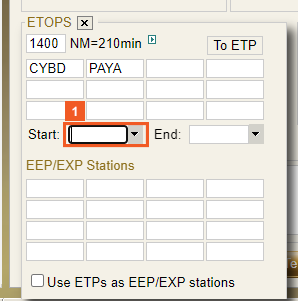
 Click the Start dropdown button.
Start: This drop-down allows you to specify which waypoint on the route of flight designates the start of ETOPS airspace. This field is initially disabled and becomes enabled once you have selected a route. If a new route is subsequently applied, the waypoint will persist if it can be found in the new route, otherwise the field is cleared.
- The ETOPS starting waypoint is disabled if an EEP/EXP station is entered, or if the Use ETPs as EEP/EXP Stations checkbox is selected.
- It is valid to specify a starting waypoint without specifying an ending waypoint.
- Specifying an ETOPS start waypoint disables the EEP/EXP stations as well as the Use ETPs as EEP/EXP Stations checkbox.
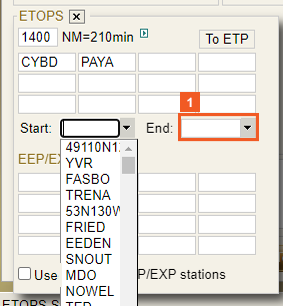
 Click the End dropdown button.
End: This drop-down list allows you to specify which waypoint on the route of flight designates the end of ETOPS airspace. This field is initially disabled and becomes enabled once you have selected a route. If a new route is subsequently applied, the waypoint will persist if it can be found in the new route, otherwise the field is cleared.
- It is valid to specify an ending waypoint without specifying a starting waypoint.
- It is an error to specify an ending waypoint that occurs at, or before the start waypoint.
- Specifying an ETOPS end waypoint disables the EEP/EXP stations as well as the Use ETPs as EEP/EXP Stations checkbox.
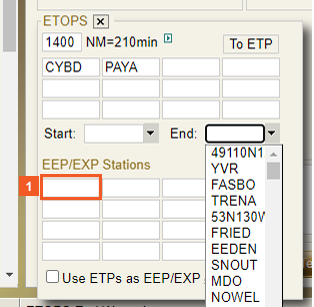
 Click the first EEP/EXP Stations input field.
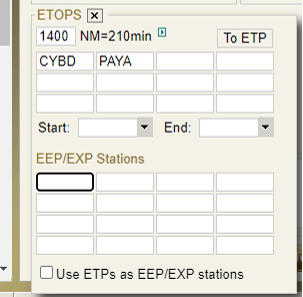
 Enter PASI into the EEP/EXP Stations field.
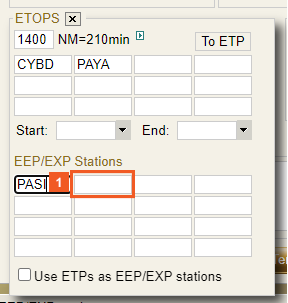
 Click the second EEP/EXP Stations input field.
PASI station shown on the map.
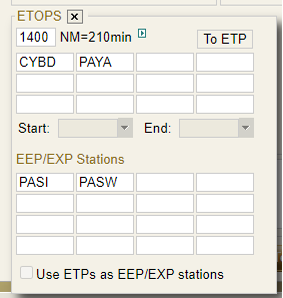
 Enter PASW into the second EEP/EXP Stations field.
N-Flight Planning (NFP) can be configured so that the system will automatically suggest suitable EEP/EXP stations along the route of flight. As long as the route stays within the 60min flight time radius of a suitable airport, ETOPS is not engaged. If a section of the route does not meet the 60min flight time radius requirement, the system will automatically engage ETOPS, and automatically populate the ETOPS airport selections.
Further end user configuration allows for ETOPS airports to automatically populate the ETP fields.
With these two configurations, the system is able to automatically ensure that the route of flight is always within 60 flight minutes of a suitable airport, and when that is not the case, the system will automatically populate the ETOPS and ETP fields with the closest suitable airports.